
Get a viewer’s attention with tried-and-true composition techniques that show you where to place your photo’s main subject.
Stay balanced.
Break your image into quadrants, aiming to balance elements in the photo using the rule of thirds as a guide. Use negative space strategically, boost saturation to pull visual weight, and practice identifying which elements in a photo throw it off balance. That way, you can easily spot and fix them next time.


Use the rule of thirds
The rule of thirds is a way of dividing frames for optimal composition. It involves evenly dividing the frame between two equally spaced horizontal and vertical gridlines, creating a three-by-three grid. In order to create balance and flow within the image, compositional elements should be placed where these lines of the grid intersect or segment your image.
“You want to move your eye around that image and find things with that trio,” — Long
This tends to allow for more interesting images than simply centering a subject. A photo with an interesting element in only one section likely won’t be as successful as a photo that’s interesting top-to-bottom and side-to-side.
Balance images
Balance is related to, but distinct from, symmetry. A balanced image doesn’t necessarily look the same right-to-left or side-to-side. Rather, the various quadrants of the image complement each other in aesthetically pleasing ways. A viewer’s eye will likely scan the picture, looking for a point of interest and something else in dialogue with that point — an obvious subject might be balanced on the other side of the image by negative space.

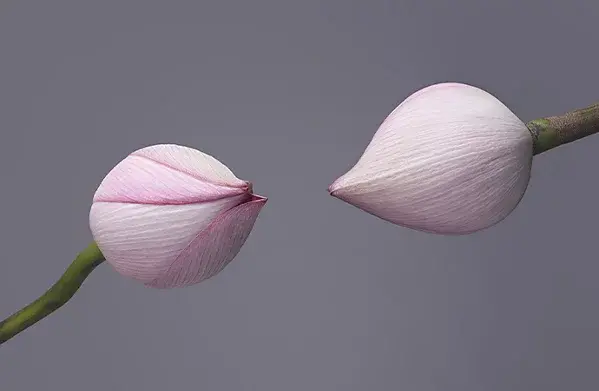
Loud or vivid colors often demand attention and disrupt or complicate. “The saturation of certain hues is really going to pull your eye,” says Long. “If I want something to pull more visual weight, increasing its saturation or its luminance can be useful.”
Unbalanced photos can look disorienting or amateurish. “When a photograph is out of balance it provides uneasiness,” says Long. “The majority of the time we like a sense of fluidity with the image.”
Things on the left correspond with things on the right, and perhaps they circle around something in the middle. Like having a feel for aesthetics or good intuition about images, recognizing balance comes with practice. “Balance isn’t something you can teach people,” says Long. “You really get a sense of it as you look at things.”
Work with leading lines, focus, and depth of field
Photography flattens three dimensions into two. In order to preserve a feeling of space and dimensionality, a photographer has to be aware of what’s in a shot and how they’re focusing on it.
Leading lines are visual elements that pull the viewer’s eye toward a subject or focal point. They can be anything — roads running off into the distance, an arm stretched out toward something else, tree branches rising toward the moon.
Focus and depth of field also add to the illusion of a third dimension within the photo. Shallow depth of field can give the viewer the impression that they’re focused on something immediately in front of them.

Find the right point of view
If you want to play with composition, move around. Simply changing perspective can mean the difference between a great photo and a conventional one. ”All we’re doing is choosing to exclude things or include things,” says Long.
“I move around a lot,” says Rivera. “I get really low or really high. I see what it’s like if I get under my subject or see what it’s like if they move side-to-side.” Get close, get far, and move to find how you want to frame your subject.
Lastly, when you’re composing a shot, keep in mind how the image is ultimately going to be used. Allow for potential extra elements (like text) when you’re lining up the shot.

Improve composition with post-production cropping
If the composition of a photo is a little off, it’s often possible to improve it in post-production with a quick crop. By moving the edge of the frame, you can often find a good image within a mediocre one. “Play with the rotation of the image,” says Rivera. “When you do a crop you can rotate it, flip the image, or put it upside down and maybe see something else.”
Getting composition right
You need to do more than just follow compositional rules to shoot good photos. Understand that the elements of composition aren’t like algorithms or formulas — they help guide a photographer’s decision-making skills, not substitute for them.
“Leading lines are great, but hopefully they’re leading me to your subject and not leading me to nowhere,” says Long.
Photography composition rules are the foundation. After you’ve internalized the fundamentals, you can break the rules. “Once you have the basics down, you can experiment,” says Rivera. “There are no set rules for how you should shoot anything. That’s the beauty of being an artist.”
Good photographers have an eye for subjects and scenes. Composition is a tool they can use to help others see what they see. They collect elements of a wide world and organize it pleasingly within a rectangle.